Brakes are the single most safety-critical system on your vehicle. Unlike engine problems that announce themselves gradually, brake failures can escalate from warning signs to dangerous situations in a matter of days. Knowing what to listen and feel for could prevent an accident.
Squealing or High-Pitched Screeching
This is intentional. Brake pad manufacturers build in a metal wear indicator that contacts the rotor when the pad reaches minimum thickness — producing a squealing sound to alert you that replacement is due. The squealing typically occurs when braking from low speeds and may be intermittent at first.
This is your warning signal. At this point, pads can typically be replaced without rotor damage. Ignore it, and within a few hundred miles, you reach the next stage.
Grinding or Metal-on-Metal Sound
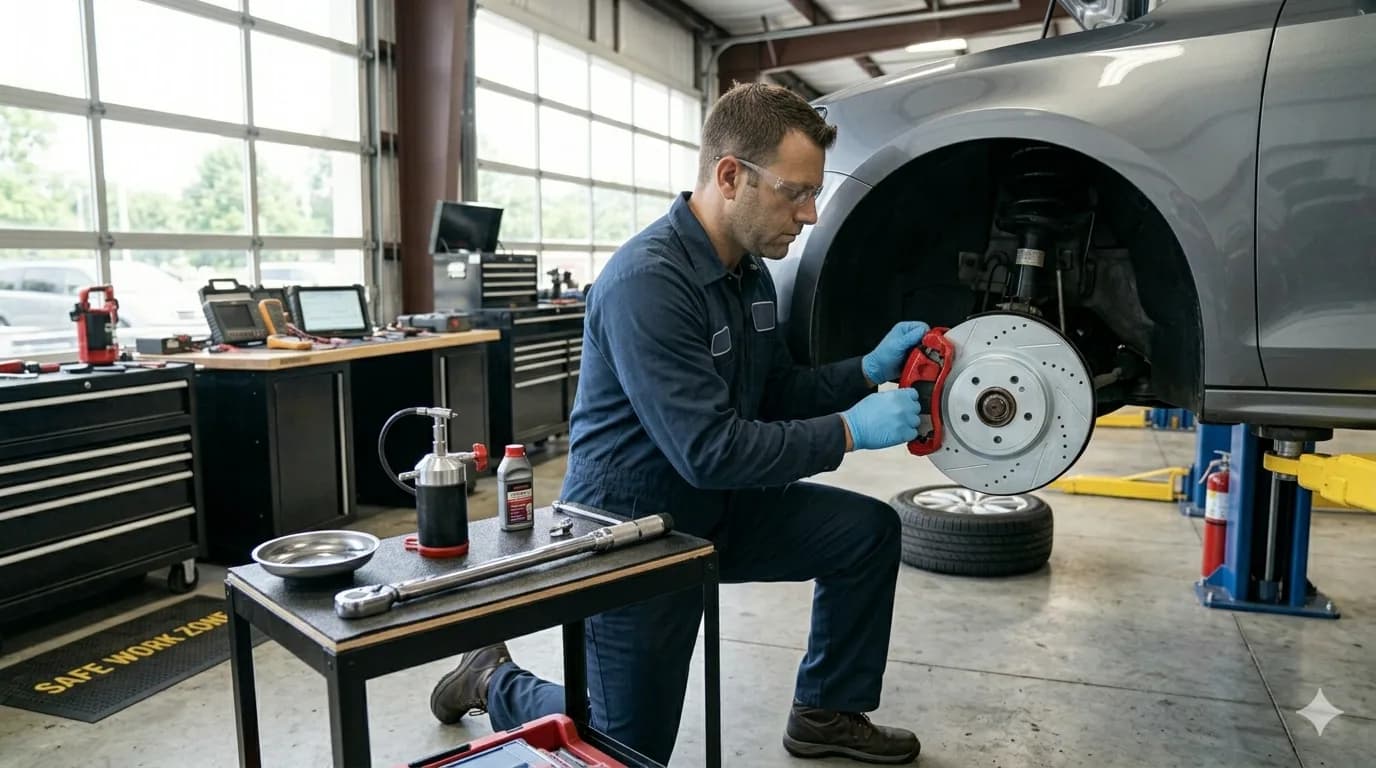
Once pads are fully worn, the metal backing plate contacts the rotor directly. The grinding sound is metal destroying metal — your brake rotor is being scored with every stop. At this stage, you need both new pads and new rotors. What would have been a $180–$250 job has become $350–$500.
Continued driving with grinding brakes also generates dangerous heat and reduces stopping power significantly. This is a same-day repair situation.
Soft or Spongy Brake Pedal
A pedal that travels further than normal before the brakes engage — or that continues to sink slowly toward the floor — indicates air in the brake lines or a failing master cylinder. Hydraulic brake systems transmit force through fluid. Air compresses; fluid doesn't. Air contamination means reduced braking force and unpredictable pedal feel.
A pedal that sinks to the floor is a brake system failure requiring immediate attention. Do not drive the vehicle.
Pulling to One Side When Braking
If the car pulls left or right during braking, one brake is applying more force than the other. Common causes include:
- Uneven pad wear (one side worn more than the other)
- Stuck brake caliper (not releasing fully, dragging on the rotor)
- Collapsed brake hose (restricting fluid flow to one caliper)
- Contaminated brake pads (oil or fluid on the friction material)
Vibration or Pulsation Through the Pedal
A pulsating pedal — felt as a rhythmic vibration when braking — almost always means warped rotors. Rotors warp from thermal stress: repeated heavy braking without adequate cooling, or parking with hot brakes. Every revolution, the high spot contacts the pad, creating the pulse you feel at the pedal.
Lightly warped rotors can sometimes be resurfaced (machined flat). Heavily warped or scored rotors require replacement.
Brake Warning Light Illuminated
The red brake warning light has multiple triggers: the parking brake is engaged (check first), brake fluid level is low (inspect for leaks), or the ABS/brake system has detected a fault. A solid red light requires inspection before your next drive. An ABS light alone — without the red brake light — indicates an issue with the anti-lock system specifically.
Brake Inspection at Chapman Mobil in Orange CA
We inspect brake pad thickness, rotor condition, caliper function, brake fluid condition, and brake line integrity as part of every free multi-point inspection. If you're noticing any of the signs above, call (949) 672-8954 or book online for same-day brake service. Our shop is at 4502 E. Chapman Ave #92 in Orange — serving Anaheim, Tustin, Villa Park, and all of Orange County.